This section guides you through setting up, configuring, and managing the NetApp SolidFire integration in OpsRamp.
Prerequisites
- Provide required discovery inputs: ipAddress, port, isSecure, credentials
- Expose the HTTP/HTTPS administration endpoints referenced by the SDK for inventory and monitoring.
Configure NetApp SolidFire Integration
Click here to Configure and Install the NetApp SolidFire integration
- To select your client, navigate to All Clients, and click the Client/Partner dropdown menu.
Note: You may either type your client’s name in the search bar or select your client from the list. - Navigate to Setup > Account. The Account Details screen is displayed.
- Click Integrations. The Installed Integrations screen is displayed with all the installed applications.
Note: If you do not have any installed applications, you will be navigated to the Available Integrations and Apps page with all the available applications along with the newly created application with the version. - Click + ADD on the Installed Integrations page.
Note: Search for the integration either by entering the name of the integration in the search bar or by selecting the category of the integration from the All Categories dropdown list. - Click ADD in the NetApp SolidFire application.
- In the Configuration screen, click + ADD. The Add Configuration screen appears.
- Enter the following BASIC INFORMATION:

| Field Name | Description | Field Type |
|---|---|---|
| Name | Enter the name for the integration | String |
| IP Address/Host Name | IP address/host name of the target. | String |
| Port | Port Note: Default port is 443 | Integer |
| Credentials | Select the credentials from the drop-down list. Note: Click + Add to create a credential. By default the Is Secure checkbox is selected. IP Address/Host Name and Port Should be accessible from Gateway. | Dropdown |
| App Failure Notification | If turned on, you will be notified in case of an application failure. | Checkbox |
| Event Polling | Enables integrating third party alerts into OpsRamp using further configurations. | Checkbox |
| Alert On Root Resource | Alerts generated by on root resource | Checkbox |
| Alert Severity | Possible values of Alert Severity Filter configuration property are warning, critical, error. | String |
| Alert Severity Mapping | Possible values of Alert Severity Mapping Filter configuration property are "critical":"Critical", "error":"Critical", "warning":"Warning". | String |
- CUSTOM ATTRIBUTES: Custom attributes are the user-defined data fields or properties that can be added to the preexisting attributes to configure the integration.
| Field Name | Description | Field Type |
|---|---|---|
| Custom Attribute | Select the custom attribute from the dropdown. You can add attributes by clicking the Add icon (+). | Dropdown |
| Value | Select the value from the dropdown. | Dropdown |
Note
The custom attribute that you add here will be assigned to all the resources that are created by the integration. You can add a maximum of five custom attributes (key and value pair).- In the Native Types section, select the native types to be discovered.
- In the DISCOVERY SCHEDULE section, select recurrence pattern to add one of the following patterns:
- Minutes
- Hourly
- Daily
- Weekly
- Monthly
- Click ADD.
Note
Sample values shown in the configuration fields are for illustration purposes only. Use your actual integration details when configuring.The configuration is saved and displayed on the configurations page after you save it.
Note
From the same page, you may Edit and Remove the created configuration.- Under the ADVANCED SETTINGS, Select the Bypass Resource Reconciliation option, if you wish to bypass resource reconciliation when encountering the same resources discovered by multiple applications.
Note: If two different applications provide identical discovery attributes, two separate resources will be generated with those respective attributes from the individual discoveries. - Click NEXT.
- (Optional) Click +ADD to create a new collector. You can either use the pre-populated name or give the name to your collector.
- Select an existing registered profile.

- Click FINISH.
The integration is installed and displayed on the INSTALLED INTEGRATION page. Use the search field to find the installed integration.
Modify NetApp SolidFire Integration
See Modify an Installed Integration or Application article.
Note: Select the NetApp SolidFire application.
Discover Resources in NetApp SolidFire Integration
Click here to View the NetApp SolidFire Details
To discover resources for NetApp SolidFire:
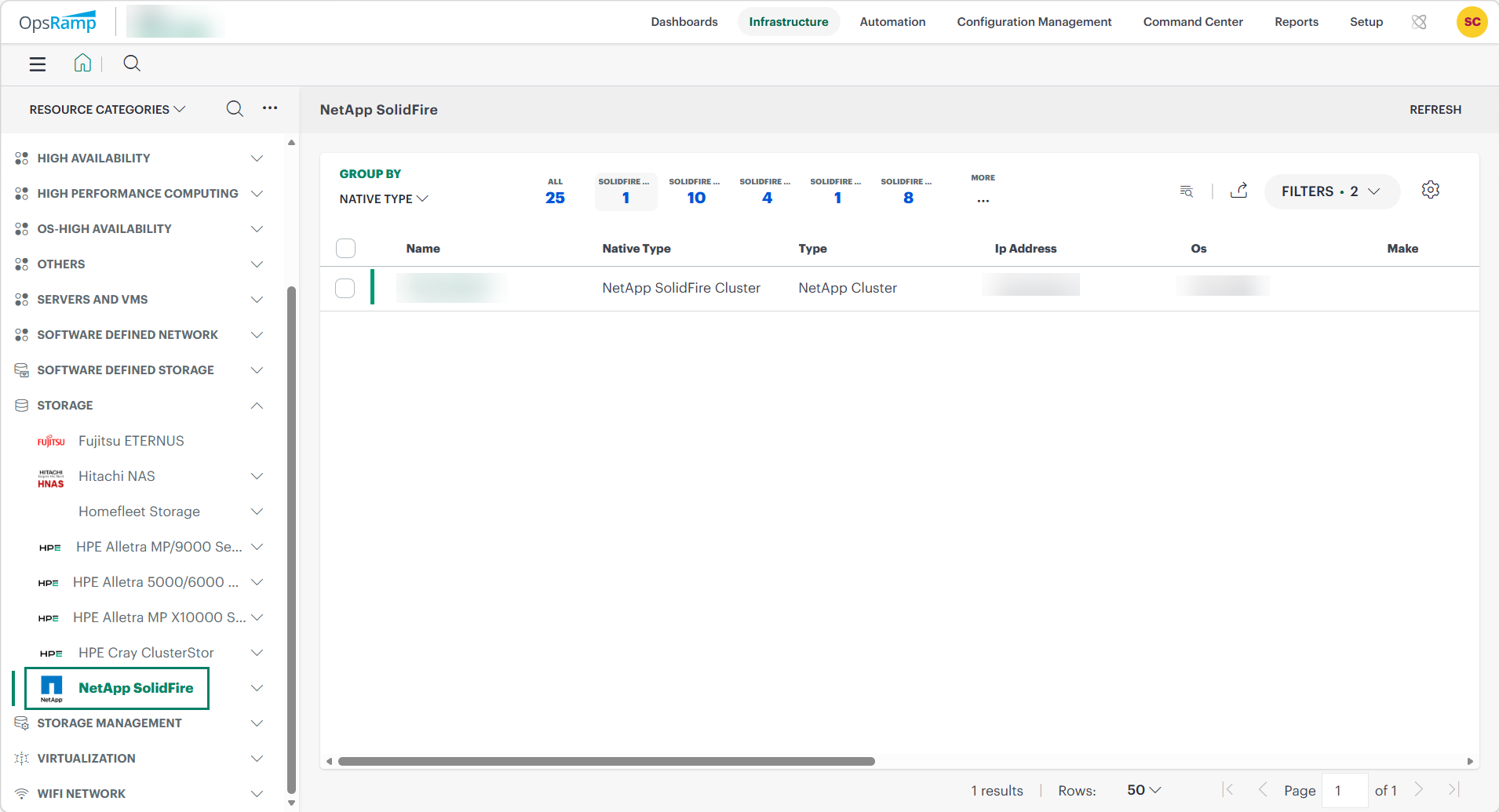
- Navigate to Infrastructure > Search > STORAGE > NetApp SolidFire.
- The SOLARIS OS SERVER page is displayed, select the application name.
- The RESOURCE DETAILS page appears from the right.
- Click the ellipsis (…) on the top right and select View details.
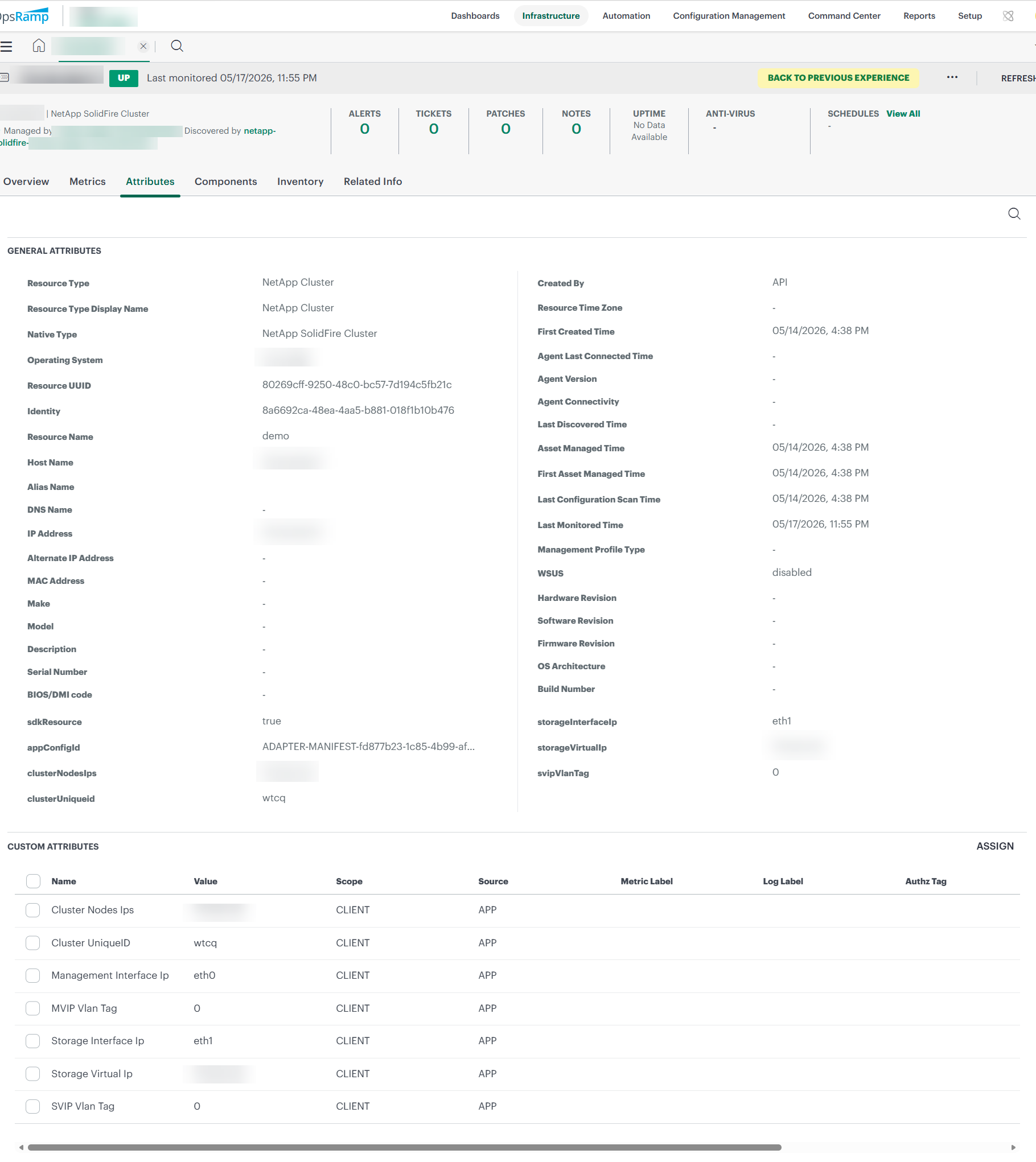
- Navigate to the Attributes tab to view the discovery details.
View resource metrics
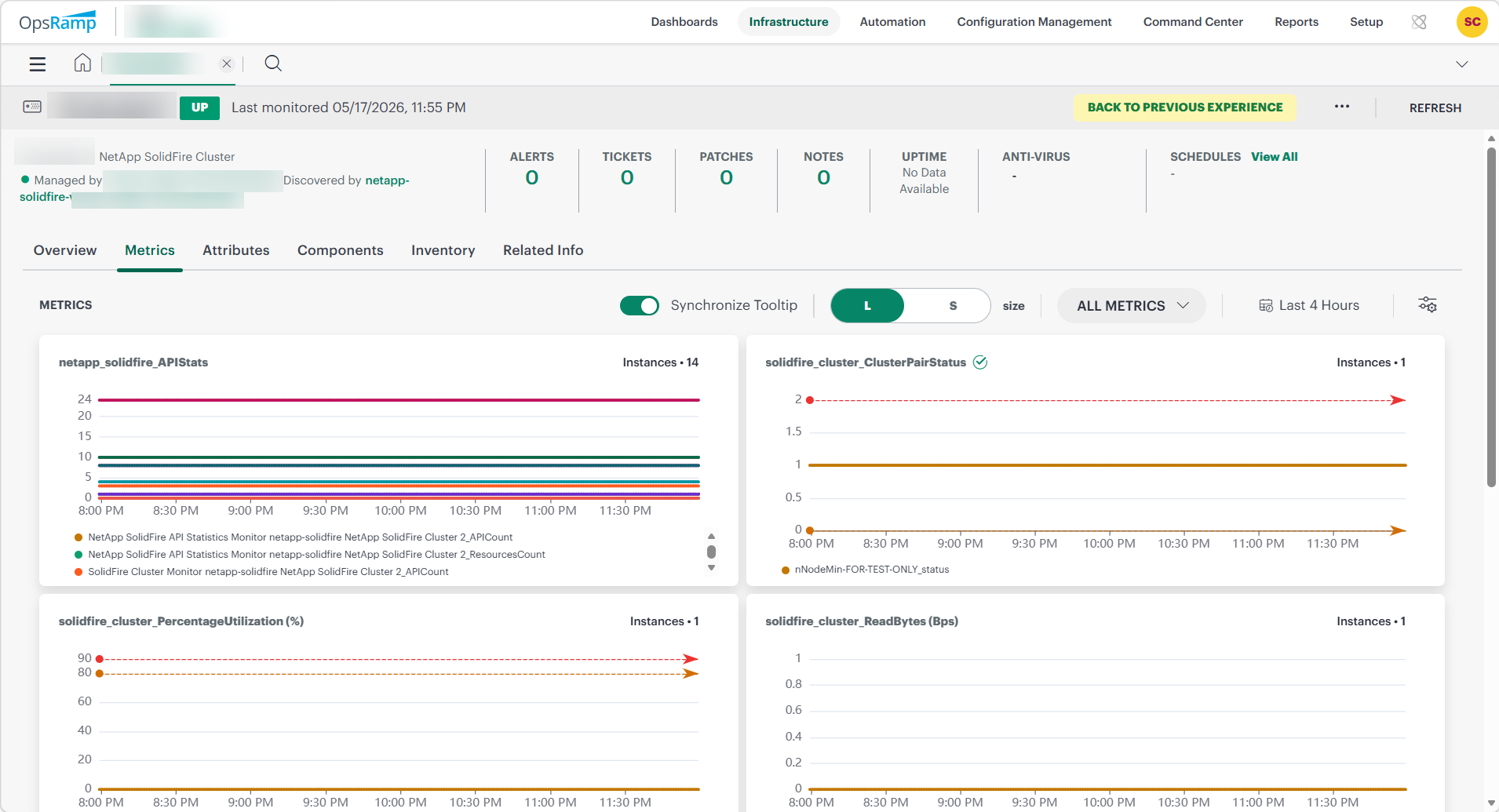
To confirm NetApp SolidFire monitoring, review the following:
- Metric graphs: A graph is plotted for each metric that is enabled in the configuration.
- Alerts: Alerts are generated for metrics that are configured as defined for integration.
- Click the Metrics tab to view the metric details for NetApp SolidFire.
×![]()