Introduction
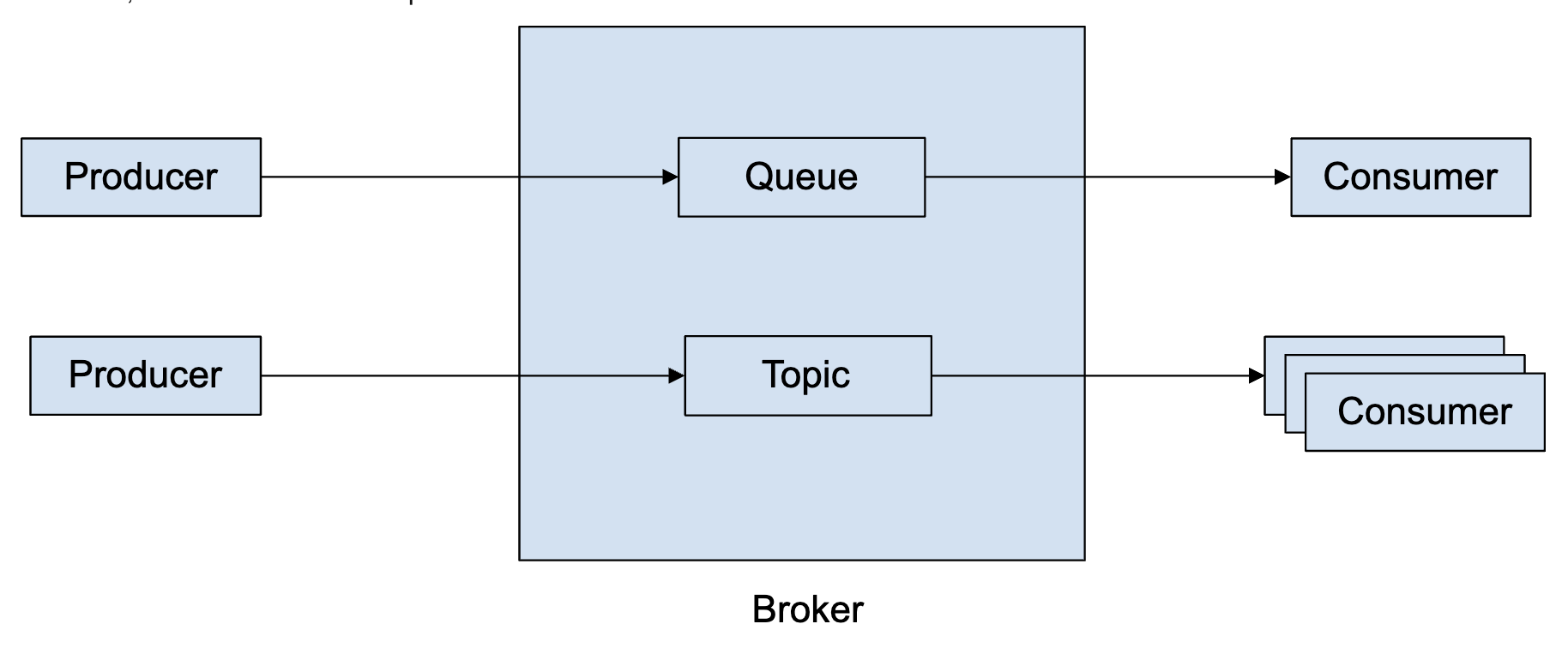
Apache ActiveMQ is an open-source, Java-based message broker that powers asynchronous communication between applications. It sends and receives messages through queues (point-to-point) and topics (publish-subscribe), and supports multiple protocols including AMQP, MQTT, STOMP, OpenWire, and REST. It integrates seamlessly with Java EE, Spring, and other enterprise platforms.
ActiveMQ plays a central role in building loosely coupled, reliable, and scalable messaging-based systems for microservices, event-driven architectures, and enterprise messaging patterns.
The following are the key components of ActiveMQ integration.
| Component | Description |
|---|---|
| Broker | Routes and manages messages; handles clients, maintains queues/topics, ensures delivery, and manages persistence. |
| Destinations | Defines where messages are sent or received. Two types: • Queue – supports point-to-point messaging • Topic – supports publish-subscribe messaging |
| Producer | Sends messages to destinations (queues or topics). |
| Consumer | Receives messages from destinations; operates synchronously or asynchronously. |
| Connection | Represents a network link between client and broker; typically created using JMS or other supported APIs. |
| Session | Provides a single-threaded context for producing and consuming messages; manages transactions. |
| Message | Represents the data being exchanged; supports text, bytes, map, object, and stream message types. |
| Persistence Store | Stores messages to disk for durability; uses KahaDB by default in ActiveMQ Classic. |
| Network Connector | Forms a network of brokers; forwards messages between brokers to support high availability and scalability. |
| Advisory Messages | Generates system messages to monitor events like consumer subscriptions and destination creation. |
To help you get started, here’s what you can do next:To configure the integration, see Working with ActiveMQ.
Use Cases
Discovery
- Discovers all the high-level components such as ActiveMQ Broker, ActiveMQ Queue, and ActiveMQ Topic.
- Publishes relationships between resources to enable a topological view and simplify maintenance.
- For more information on Heirarchy of HPE Alletra, see Resource Hierarchy
Monitoring
- Provides monitoring related to availability, capacity, performance, and usage.
- Generates alerts when defined metric thresholds are breached, notifying users of potential issues.
- For a complete list of supported metrics and details on the default monitoring configurations, see Supported Metrics and Default Monitoring Configuration
Supported Target Versions
- Include application version, API version (if applicable), and any platform limitations.
Resource Hierarchy
The following is the resource hierarchy for ActiveMQ integration.
- ActiveMQ Broker
- ActiveMQ Queues
- ActiveMQ Topics
Version History
| Application Version | Bug fixes / Enhancements |
|---|---|
| 1.1.0 | This implementation introduces third-party CI alert mapping and OpsQL-based enhancements.Configure alert mappings to target CI systems through the application configuration. After configuration, the system automatically forwards alerts to the corresponding third-party platforms and maps them to the specified CIs, ensuring consistent integration and efficient alert management.Previously, resource filters in the app configuration required manual entry of resource core and custom attributes. With this enhancement, the configuration is moved to OpsQL-based filtering, where users can see the keys auto-populated as needed. |
| 1.0.0 | Initial version with discovery, monitoring, and Implementations. |