Introduction
The OpsRamp NextGen Gateway is the advanced, cloud-native successor to the OpsRamp Classic Gateway. It is designed to deliver high availability, scalability, and simplified onboarding for modern hybrid IT environments.
Key Highlights
- Cloud-native architecture built on microservices and Kubernetes.
- High scalability to support complex hybrid and multi-cloud infrastructures.
- Simplified onboarding with automated bootstrap deployment.
- Cross-platform compatibility for Linux, macOS, and Windows environments.
Modern Architecture
The NextGen Gateway is powered by a Kubernetes-based microservices architecture, representing a major advancement in IT Operations Management (ITOM).
This design offers:
- Flexibility – Seamless integration with the Kubernetes ecosystem.
- Efficiency – Streamlined discovery, monitoring, and lifecycle management.
- Innovation – A first-of-its-kind approach in the ITOM space, purpose-built for evolving enterprise IT needs.
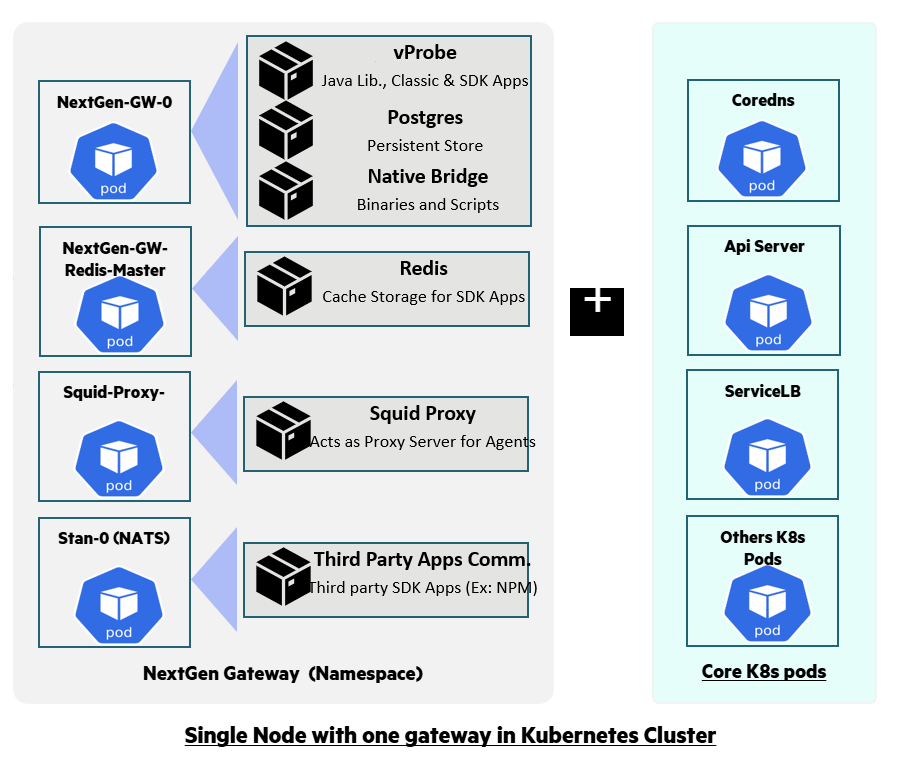
A high-level NextGen Gateway architecture is shown in the following diagram:
Key Components
NextGen Gateway runs as a pod in a k8s cluster within a namespace. It consists of the following key components:
- Vprobe: The core container of the gateway, responsible for discovery, monitoring, and scheduling tasks at regular intervals based on configuration. It also establishes connectivity to the cloud.
- Nativebridge: A helper container for the vprobe container that executes commands and scripts.
- Postgres: A helper container for the vprobe container that persists data.
- Squid Proxy (Optional): An optional pod that acts as a proxy for OpsRamp Agents, enabling them to securely establish outbound connectivity to the OpsRamp Cloud in restricted or proxy-based network environments.
- Redis: A helper pod that persists SDK apps data in cache, enabling faster data access and improved performance.
Key Features
The Key features of NextGen Gateway are:
High Availability
The NextGen Gateway ensures continuous discovery, monitoring, and alerting through its high-availability design.
- Supports clustered deployments by installing gateways on multiple nodes for fault tolerance.
- If a node becomes unavailable in the cluster, then the gateways are automatically routed to another active node, ensuring uninterrupted operations.
Scalability
- Supports horizontal scaling by deploying multiple Gateway replicas using elastic profile feature.
- Uses elastic profiles to balance workloads, distributing traffic across replicas when demand increases/decreases.
Zero-Touch Onboarding
- Simplifies onboarding with automated credential creation, discovery profiles, and integrations.
- Uses YAML-based configuration for quick, low-effort onboarding.
Multi-Tenancy
- Allows registration of multiple Gateways across different tenants within a single cluster.
- Ensures operational isolation while maintaining scalability and flexibility.
Deployment with Bootstrap Tool
To simplify installation and configuration, the NextGen Gateway leverages a cross-platform bootstrap tool.
Copyleft Source Code Packages
OpsRamp Gateway contains copyleft-licensed open-source packages. The corresponding source code for these packages is available in HPE Software Center for the applicable Gateway version.
Note
Copyleft source code packages available in HPE Software Center apply only to NextGen Gateway 22.0.0.To download the copyleft source code packages:
Navigate to HPE Software Center.
In Search, search for NextGen Gateway.
From the search results, locate HPE OpsRamp NextGen Gateway OpenSource.
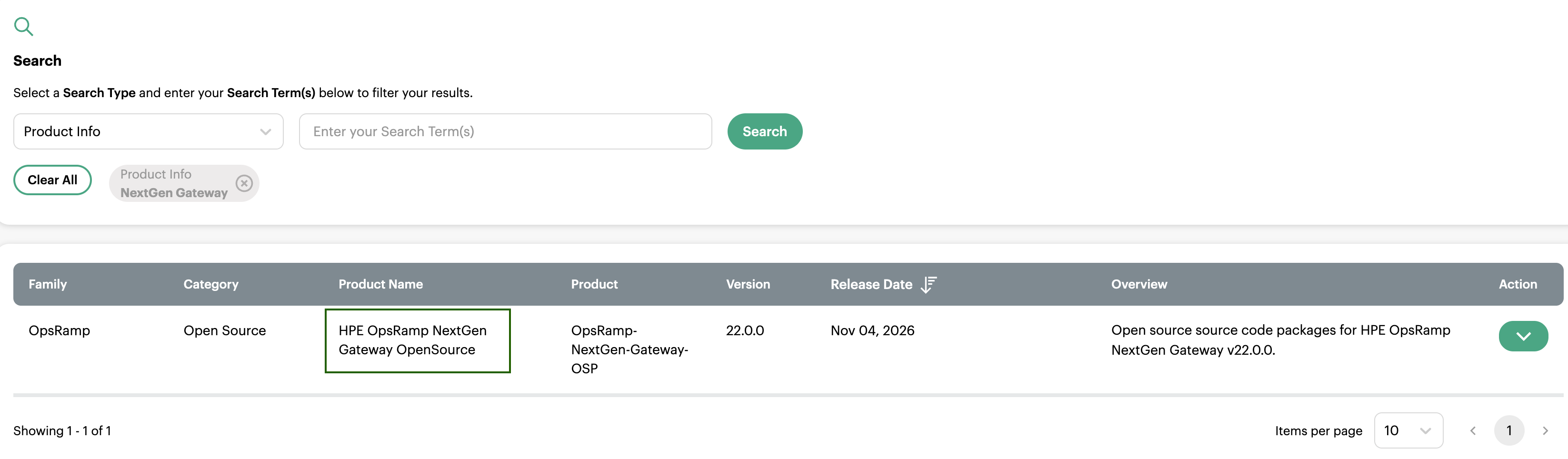
Verify the Version and select the package that corresponds to your NextGen Gateway version.
Under Action, click the down arrow for the package.
Download the available copyleft source code package.