This section guides you through setting up, configuring, and managing the HPE Homefleet Storage integration in OpsRamp.
Prerequisites
Before configuring the integration, ensure that your environment meets the following requirements related to gateway versions, credentials, and connectivity.
- OpsRamp Classic Gateway (Linux) version 14.0.0 or later.
- OpsRamp NextGen Gateway version 14.0.0 or later.
- OpsRamp recommends using the latest Gateway version for full coverage of recent bug fixes and enhancements.
- customers are expected to provide the client ID and secret of an ExtOAuthClient with the system-observer role.
- Ensure that the provided IP address/host name, port, and credentials are valid and accessible for successful integration.
- Verify network connectivity from the gateway using:ping
<IP Address/Host Name> - Check port accessibility using:
telnet <IP Address/Host Name> <Port>
- Verify network connectivity from the gateway using:ping
Configure HPE Homefleet Storage Integration
Click here to Configure and Install the HPE Homefleet Storage Integration
- To select your client, navigate to All Clients, and click the Client/Partner dropdown menu.
Note: You may either type your client’s name in the search bar or select your client from the list. - Navigate to Setup > Account. The Account Details screen is displayed.
- Click Integrations. The Installed Integrations screen is displayed with all the installed applications.
Note
If you do not have any installed applications, you will be navigated to the Available Integrations and Apps page with all the available applications along with the newly created application with the version. - Click + ADD on the Installed Integrations page.
Note: Search for the integration either by entering the name of the integration in the search bar or by selecting the category of the integration from the All Categories dropdown list. - Click ADD in the HPE Homefleet Storage application.
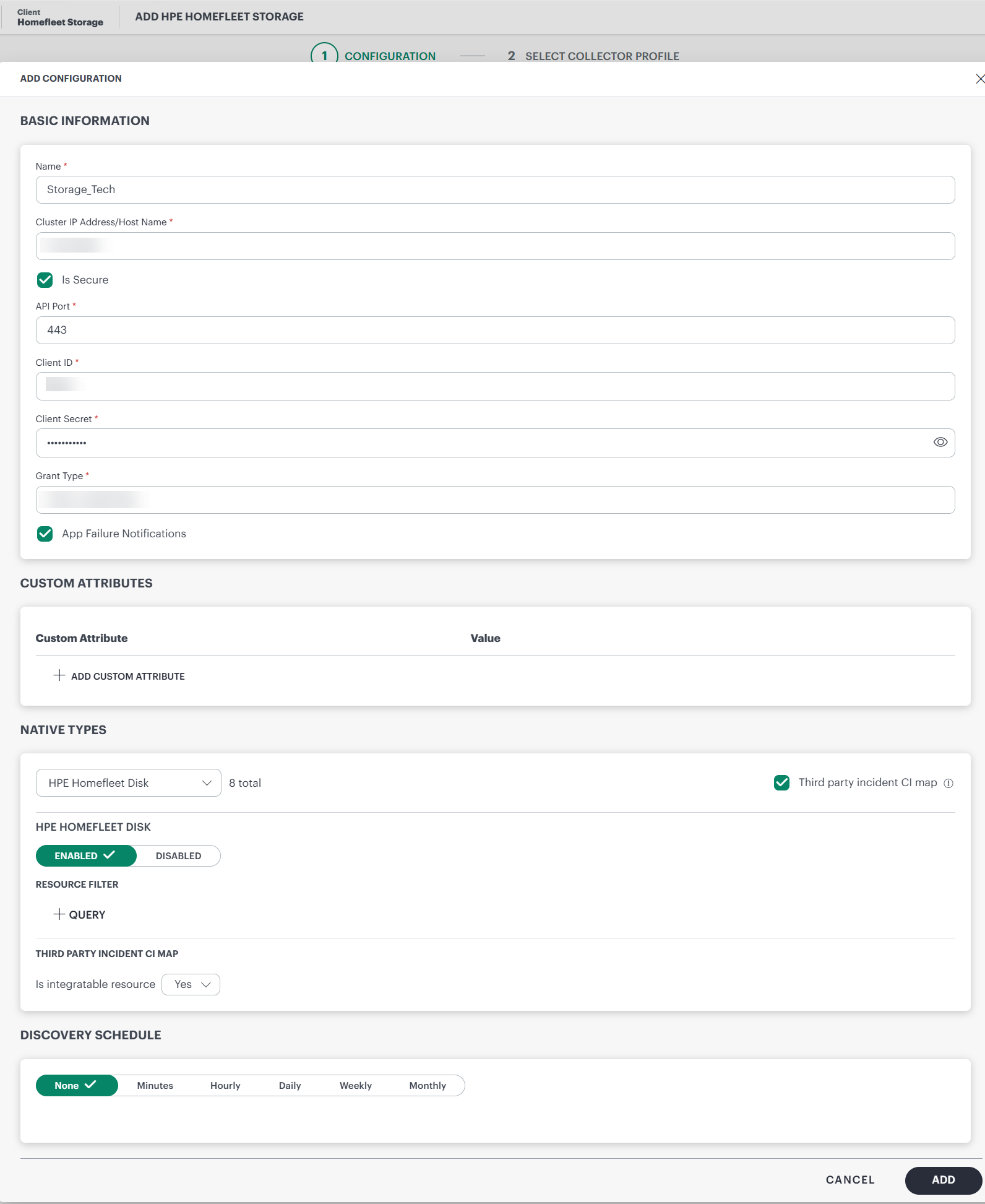
- In the Configuration screen, click + ADD. The Add Configuration screen appears.
- Enter the following BASIC INFORMATION:

| Field Name | Description | Field Type | Default Value |
|---|---|---|---|
| Name | A user-defined display name for the integration instance. | String | |
| Cluster IP Address/Host Name | Enter the management IP address or hostname of the HPE Homefleet Storage cluster. You must be able to connect to this node using HTTPS. This is the primary endpoint for all REST API and Prometheus metric queries. | String | |
| Is Secure | Select this checkbox if you want the communication between your system and the specified endpoint to be secured using HTTPS (HTTP over SSL/TLS).Default Selection: When selected, it signifies that the connection is encrypted, providing an added layer of security to the data being transmitted. | Checkbox | true |
| API Port | Provide the API Port details. The port must be open and accessible for API communication from the gateway. This port is used for both discovery REST APIs (Kubernetes-style) and Prometheus monitoring queries.Note: By default API Port is 443. | String | 443 |
| Client ID | Enter the OAuth2 Client ID used for authenticating with the Homefleet Storage cluster. The credentials must have read API access permissions for cluster, node, enclosure, filesystem, switch, JBOF IOM, and alert resources. | String | |
| Client Secret | Enter the OAuth2 Client Secret associated with the Client ID. This is used together with the Client ID to obtain an access token via the `/oauth/token` endpoint using the client_credentials grant type. | Password | |
| Grant Type | The OAuth2 grant type used for authentication. The Homefleet Storage API uses client_credentials grant type. | String | client_credentials |
| App Failure Notifications | Enable or disable application failure notification alerts. When enabled, OpsRamp generates alerts if the integration encounters connectivity or authentication failures during discovery or monitoring operations. | Checkbox | true |
- CUSTOM ATTRIBUTES: Custom attributes are the user-defined data fields or properties that can be added to the preexisting attributes to configure the integration.
| Field Name | Description | Field Type |
|---|---|---|
| Custom Attribute | Select the custom attribute from the dropdown. You can add attributes by clicking the Add icon (+). | Dropdown |
| Value | Select the value from the dropdown. | Dropdown |
Note
The custom attribute that you add here will be assigned to all the resources that are created by the integration. You can add a maximum of five custom attributes (key and value pair).- In the RESOURCE TYPE section, select:
- ALL: All the existing and future resources will be discovered.
- SELECT: You can select one or multiple resources to be discovered.
- In the DISCOVERY SCHEDULE section, select recurrence pattern to add one of the following patterns:
- Minutes
- Hourly
- Daily
- Weekly
- Monthly
- Click ADD.
Now the configuration is saved and displayed on the configurations page after you save it.
Note
From the same page, you may Edit and Remove the created configuration.12. Under the ADVANCED SETTINGS, Select the Bypass Resource Reconciliation option, if you wish to bypass resource reconciliation when encountering the same resources discovered by multiple applications.
Note
If two different applications provide identical discovery attributes, two separate resources will be generated with those respective attributes from the individual discoveries.14. (Optional) Click +ADD to create a new collector. You can either use the pre-populated name or give the name to your collector.
15. Select an existing registered profile.16. Click FINISH.
The integration is installed and displayed on the INSTALLED INTEGRATION page. Use the search field to find the installed integration.
Modify HPE Homefleet Storage Integration
Click here to Modify the Configuration
- See Modify an Installed Integration or Application article.
Note
Select HPE Homefleet Storage.Discover Resources in HPE Homefleet Storage Integration
Click here to View the HPE Homefleet Storage
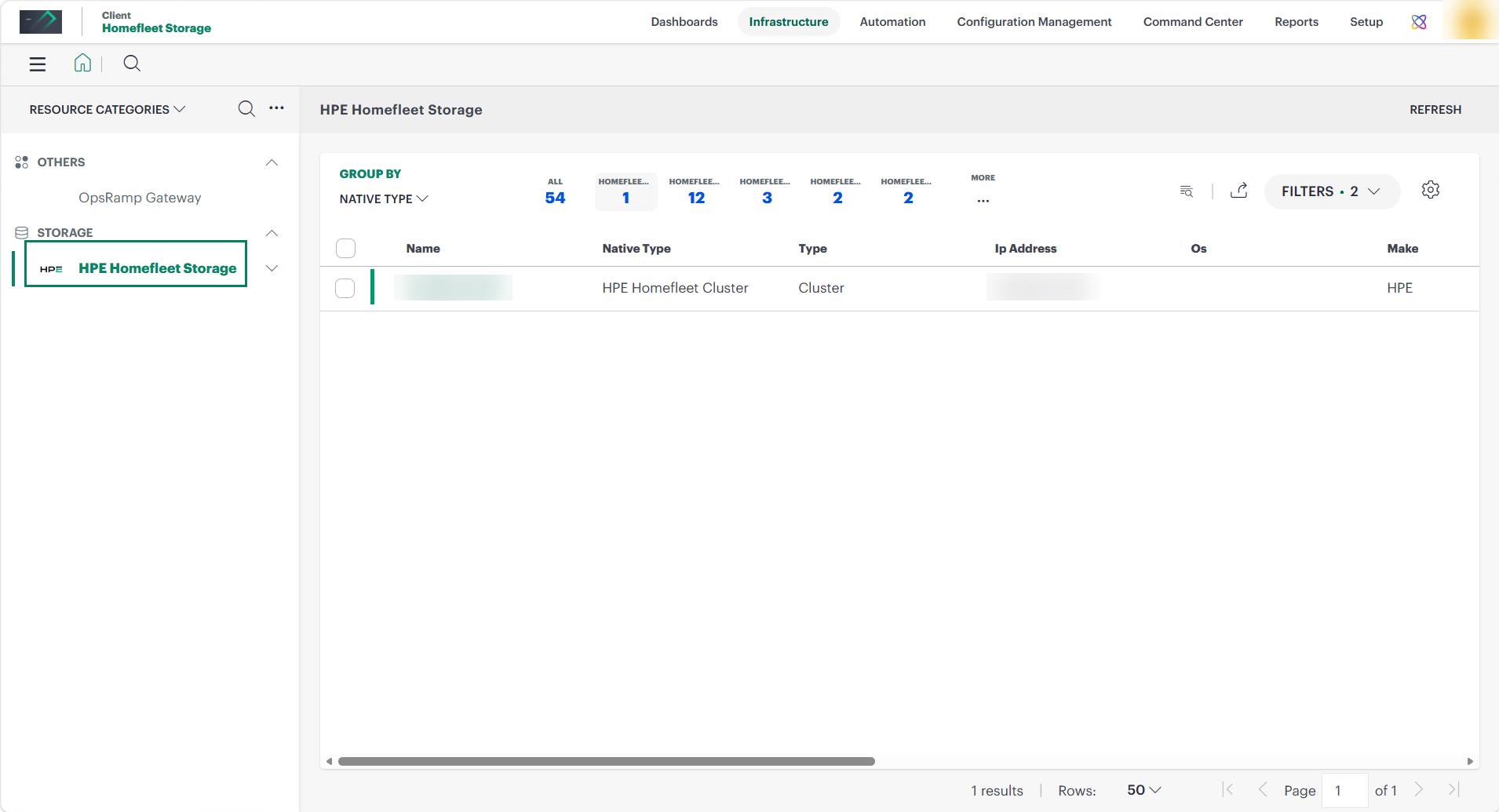
- Navigate to Infrastructure > Search > STORAGE > HPE Homefleet Storage. The HPE Homefleet Storage page is displayed.
- Select the application on the HPE Homefleet Storage page
- The RESOURCE page appears from the right.
- Click the ellipsis (…) on the top right and select View Details.
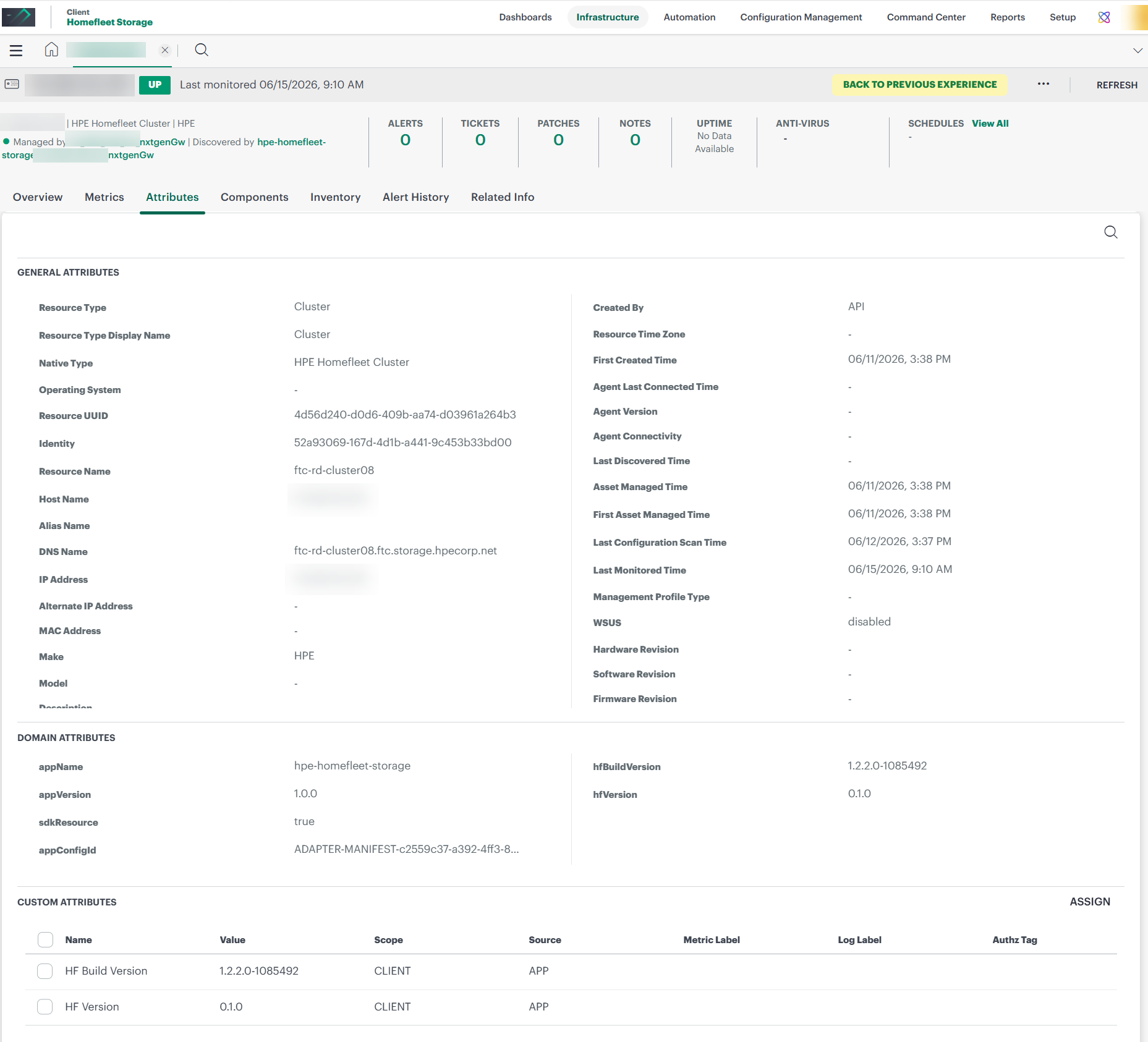
- Navigate to the Attributes tab to view the discovery details.
View resource metrics
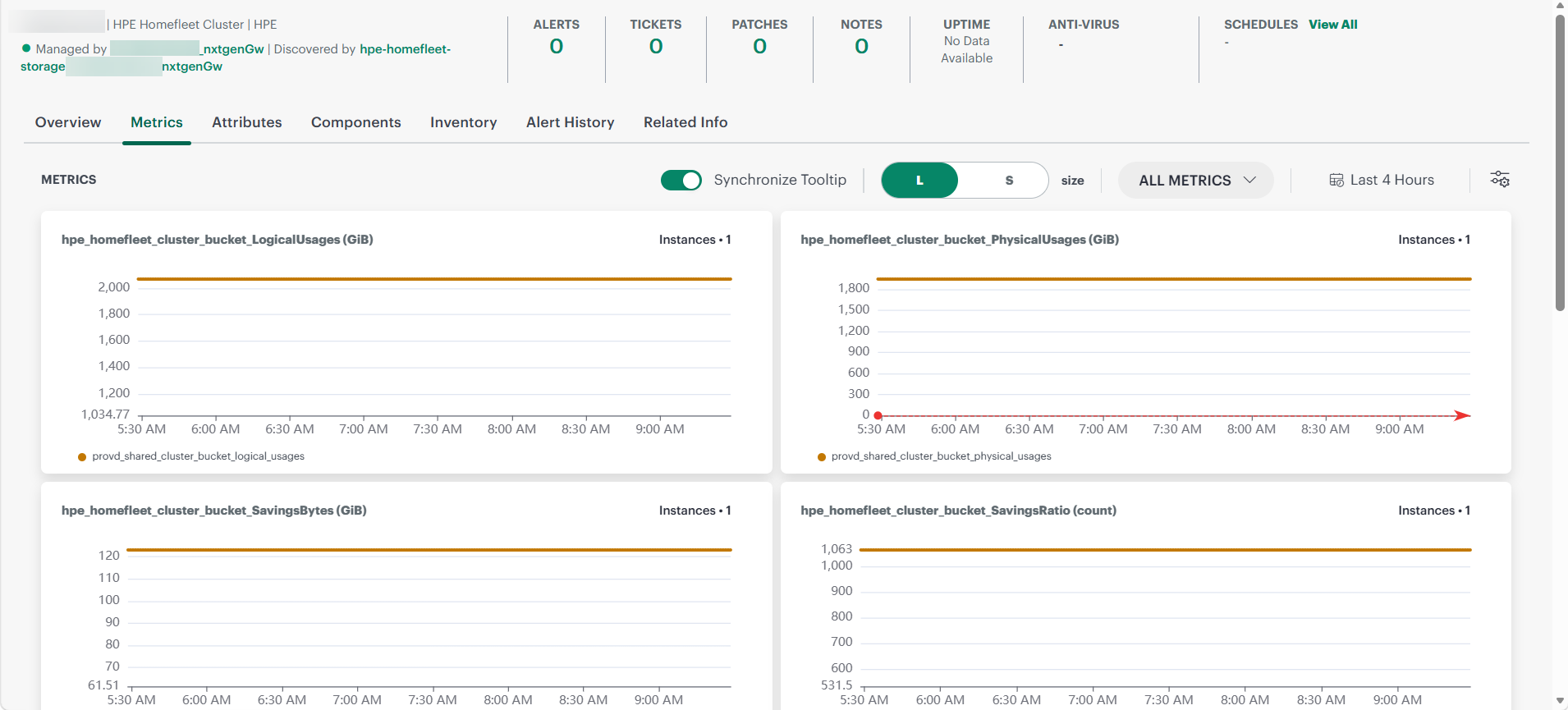
To confirm HPE Homefleet Storage monitoring, review the following:
- Metric graphs: A graph is plotted for each metric that is enabled in the configuration.
- Alerts: Alerts are generated for metrics that are configured as defined for integration.
- Click the Metrics tab to view the metric details for HPE Homefleet Storage.